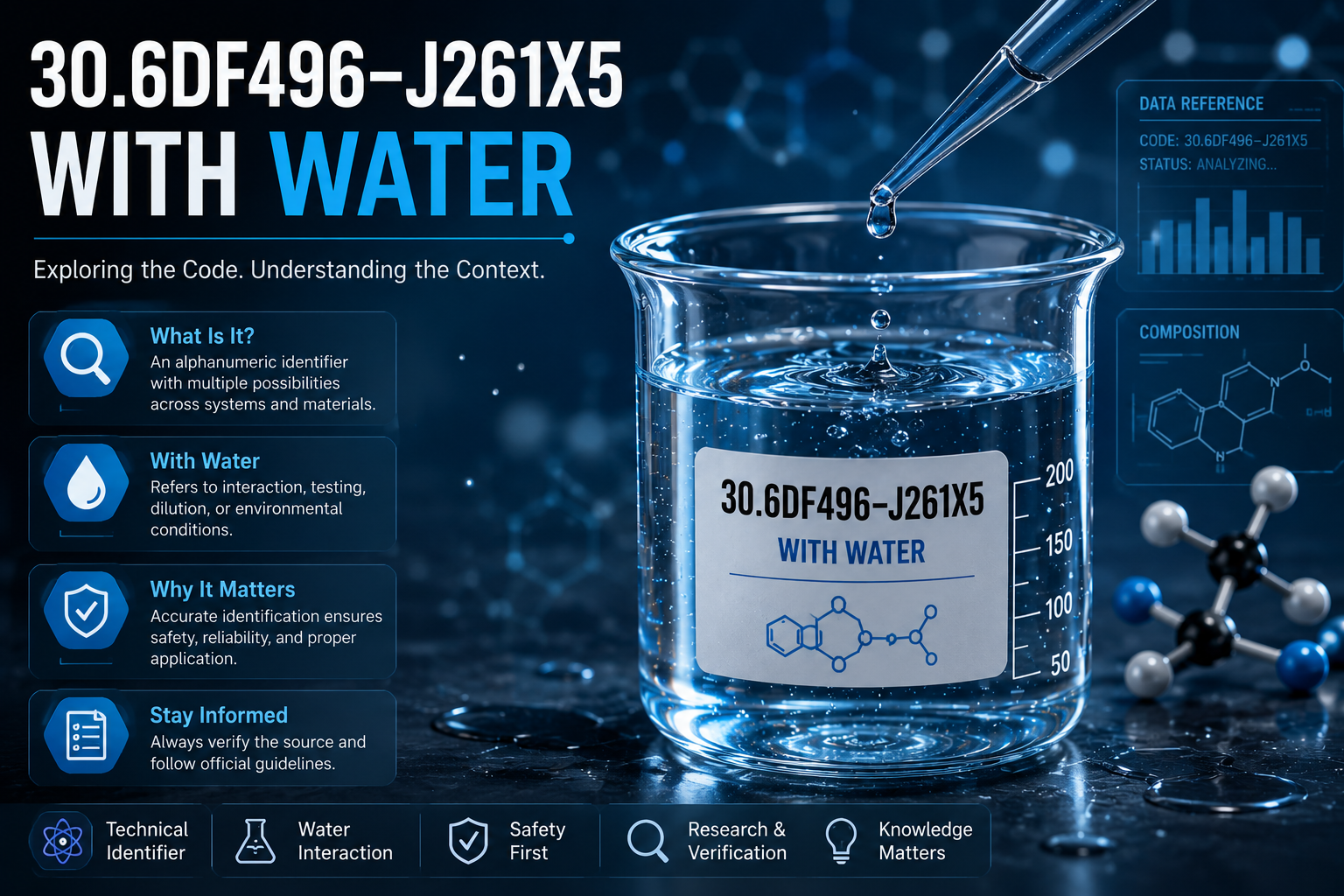
Some online search terms are easy to understand because they clearly describe a product, technology, or service. Others look completely unfamiliar and leave readers wondering what they actually mean. 30.6df496–J261X5 With Water is one of those unusual phrases.
The combination of numbers, letters, a hyphen, and the words “With Water” makes the term look like a technical identifier rather than an ordinary product name. This naturally raises questions. Is it a chemical code? Is it a laboratory reference? Could it be related to software or industrial systems? And why is water mentioned alongside it?
The most important point is that an unusual code should not automatically be treated as a known chemical, consumer product, or substance. Several websites currently discuss the phrase, but their interpretations are not fully consistent. Some describe it as a technical or experimental identifier, while another recent article claims that the code may simply be a tracking or system identifier rather than a physical substance.
This guide takes a source-conscious approach to 30.6df496–J261X5 With Water, explaining what the phrase may represent, why water could be mentioned, how such identifiers are used, and how readers can avoid misleading assumptions.
The First Clue: The Structure of the Identifier
The first thing that stands out about 30.6df496–J261X5 With Water is its unusual format.
Why Does the Code Look Technical?
The string “30.6df496–J261X5” does not resemble a normal consumer-facing name. It contains:
- Numbers
- Lowercase letters
- Uppercase letters
- A decimal point
- A hyphen
- An alphanumeric sequence
This type of formatting can occur in many digital and technical environments.
A code may be used to identify a record, sample, component, batch, product version, database entry, or internal reference. In some cases, identifiers are generated automatically by computer systems.
That means the code itself does not necessarily explain what the underlying item is.
Why Context Matters
If 30.6df496–J261X5 With Water appears in a laboratory report, it may have a different meaning from the same phrase appearing in software documentation.
Similarly, if the term appears on a product label, the surrounding manufacturer information could completely change how it should be interpreted.
The original source is therefore more valuable than the code alone.
What Does “With Water” Actually Tell Us?
The second part of 30.6df496–J261X5 With Water creates even more curiosity.
The phrase “with water” can describe several different situations, and it does not automatically mean that an unknown substance should be mixed with drinking water.
Water as a Testing Medium
In scientific and industrial environments, water is frequently used as a testing medium.
A material may be exposed to water to observe properties such as:
- Stability
- Solubility
- Physical changes
- Conductivity
- Temperature behavior
- Environmental compatibility
Therefore, the phrase “with water” could describe a test condition rather than an instruction for everyday use.
Water as a Processing Component
Water can also be involved in manufacturing, cleaning, cooling, dilution, or processing.
If a technical identifier appears alongside water in documentation, the water reference may simply describe part of the process.
This is one reason readers should avoid interpreting 30.6df496–J261X5 With Water as a simple recipe or usage instruction.
Read more: Gamification Summit.com
Water in Digital Simulations
There is also another possibility.
If the identifier belongs to software, modeling, or a database, “water” could be a parameter or environmental condition within a digital system.
In that situation, there may be no physical material involved at all.
7 Possible Meanings Behind 30.6df496–J261X5
Because the exact identity is not clearly established, it is useful to consider the main possibilities without presenting speculation as fact.
1. A Technical Identifier
The code could simply identify a record within a technical system.
This could include manufacturing databases, inventory systems, research records, or software platforms.
2. A Sample Reference
Laboratories often assign codes to samples so that researchers can track them without repeatedly using long descriptive names.
If water appears alongside the identifier, it could refer to an experimental condition.
3. A Batch or Tracking Code
Industrial organizations use identifiers to track batches, components, or production stages.
In this situation, the code would identify something rather than describe its chemical properties.
4. A Software-Generated Value
Modern software frequently creates unique strings for records and objects.
A code that looks mysterious to a human may be completely ordinary inside a database.
5. An Experimental Label
Research projects can use temporary identifiers for materials under investigation.
The meaning would normally be explained in the project’s documentation.
6. A Content or Database Reference
The identifier could also belong to an online database or content-management system.
In such cases, “water” might simply be another keyword associated with the record.
7. A Term Repeated Across Websites
Another possibility is that the phrase became visible online through one source and was later repeated by other websites.
This is important because repetition does not automatically make a claim independently verified.
How Water Interaction Is Normally Studied
When scientists investigate an unknown or newly developed material, water interaction can be an important part of testing.
Solubility Testing
Researchers may determine whether a material dissolves in water and under what conditions.
Temperature, concentration, pressure, and chemical composition can all influence the result.
Stability Testing
A material may be monitored over time to determine whether its properties change after exposure to water.
Reaction Monitoring
If a material reacts with water, researchers may monitor changes such as temperature, gas production, appearance, or chemical composition.
These are general scientific principles and should not be interpreted as confirmed properties of 30.6df496–J261X5 With Water.
Is 30.6df496–J261X5 a Chemical?
This is one of the biggest questions surrounding 30.6df496–J261X5 With Water.
At present, the identifier itself does not provide enough evidence to classify it as a standardized chemical name.
Some online sources describe it as an industrial or experimental identifier, while another recent source specifically argues that it is a tracking code rather than a physical substance.
Because these interpretations differ, a responsible article should not claim a specific chemical identity without an authoritative source.
A genuine chemical identification would normally be supported by information such as:
- An official chemical name
- CAS or another recognized identifier
- Manufacturer documentation
- Safety Data Sheet
- Laboratory record
- Technical specification
Without such evidence, the exact identity remains uncertain.
Read more: Emerging Markets: Are They Worth the Risk
Can You Mix 30.6df496–J261X5 With Water?
The safest answer is: do not mix an unidentified material with water simply because the phrase contains the words “With Water.”
That wording does not automatically constitute an instruction.
If the code refers to software or a database record, there may be nothing physical to mix.
If it refers to a laboratory or industrial material, the correct handling procedure should come from official documentation.
Why Guessing Is a Bad Idea
Different substances can behave very differently when exposed to water.
Some dissolve.
Some remain suspended.
Some separate into layers.
Some can react and release heat or gases.
Others may remain largely unchanged.
Without knowing what the identifier represents, predicting its behavior would be unreliable.
Safety First: What Readers Should Avoid
When researching 30.6df496–J261X5 With Water, safety should come before experimentation.
Do Not Consume an Unknown Material
An unidentified code should never be treated as evidence that something is food-grade or safe to drink.
Do Not Mix Unknown Materials
Do not combine an unidentified substance with water, household chemicals, solvents, or cleaning products without verified instructions.
Do Not Heat It
Heating an unknown substance can alter its behavior and may create additional risks.
Do Not Apply It to Your Skin
A technical identifier does not establish that a material is safe for cosmetic or personal use.
Keep Original Documentation
If you encounter the identifier on packaging or equipment, preserve the label and surrounding information. Those details may be essential for proper identification.
Why Online Claims About the Code Differ
Search results about 30.6df496–J261X5 With Water currently show different interpretations.
One article presents the phrase as potentially connected to technical, experimental, or industrial contexts. Another recent article takes a substantially different position, describing the identifier as a tracking code rather than a substance.
This disagreement is an important lesson in online research.
Search Results Are Not the Same as Proof
A webpage appearing in Google does not automatically mean its claims are verified.
Similarly, multiple websites repeating one explanation may simply be reproducing the same original information.
Always Look for the Primary Source
When possible, find:
- The original document
- Manufacturer information
- Research publication
- Official database
- Technical manual
- Safety documentation
Primary evidence is much stronger than unsupported blog speculation.
A Simple Verification Process
If you encounter 30.6df496–J261X5 With Water, follow these steps.
Step 1: Copy the Exact Code
Keep the punctuation, capitalization, numbers, and hyphen exactly as they appear.
Step 2: Identify Where You Found It
Record whether it appeared on a website, label, PDF, application, research paper, or another source.
Step 3: Search the Complete Phrase
Search the full phrase instead of searching only “J261X5.”
Step 4: Look for Surrounding Terms
Words appearing before or after the code may reveal its purpose.
Step 5: Find an Authoritative Source
If the code represents a real product or material, look for official documentation.
Step 6: Do Not Experiment Before Verification
If the code refers to a physical substance, identify it before handling it.
Could the Code Be Related to Technology?
Absolutely.
The structure of 30.6df496–J261X5 With Water is compatible with the kind of machine-readable identifier that can appear in modern digital systems.
Databases
A database may assign unique values to records.
Software
Applications can generate identifiers for sessions, objects, transactions, or other data.
Supply Chains
Inventory and logistics systems depend on codes to track products and batches.
Research Platforms
Scientific databases may use identifiers to organize samples and experiments.
This means the phrase should not automatically be interpreted as a chemical or physical material.
Why Unusual Codes Attract Search Traffic
There is a simple reason people search unusual terms.
They want an explanation.
When users encounter a code they do not recognize, they often copy it directly into a search engine. If enough people do this, the phrase can begin appearing across multiple websites.
That can create a cycle:
Unknown term → searches increase → articles appear → more people discover the term → searches increase further.
This may help explain the online visibility of 30.6df496–J261X5 With Water.
What Makes a Good Explanation of This Topic?
A useful article should not simply repeat a mysterious claim.
Instead, it should answer three questions:
What Do We Know?
The code exists as a searchable phrase and is being discussed online.
What Is Uncertain?
Its exact identity and relationship with water are not clearly established by authoritative public documentation.
What Should Readers Do?
They should verify the original source and avoid treating an unknown identifier as a physical substance or usage instruction.
This approach gives readers useful information without creating false certainty.
30.6df496–J261X5 With Water: Key Takeaways
The most important points can be summarized simply.
- 30.6df496–J261X5 With Water is an unusual alphanumeric phrase.
- The identifier does not clearly establish itself as a standard chemical name.
- “With Water” can describe testing, processing, dilution, environmental exposure, or another context.
- Online sources currently provide different interpretations.
- The original source is essential for accurate identification.
- An unknown physical substance should not be mixed with water without verified instructions.
- Repeated online claims are not automatically proof.
- Technical identifiers can appear in software, databases, laboratories, manufacturing, and logistics.
Frequently Asked Questions
What is 30.6df496–J261X5 With Water?
It is an unusual alphanumeric phrase whose exact identity and purpose depend on the context in which it appears. Current online sources do not provide a single consistently verified explanation.
Is 30.6df496–J261X5 a chemical?
The identifier alone does not establish that it is a chemical. It could potentially be a technical, database, tracking, experimental, or software-related reference.
Can 30.6df496–J261X5 be mixed with water?
Do not assume that it should be mixed with water. If it refers to a physical material, use only verified instructions from the appropriate official source.
Why is water mentioned with the identifier?
Water could represent a testing medium, dilution condition, processing component, environmental variable, or simply a term associated with a digital record.
Is 30.6df496–J261X5 safe?
Its safety cannot be determined from the code alone. If the identifier refers to an unknown physical material, it should be treated cautiously until its identity is confirmed.
Where can the identifier come from?
Possible sources include technical documents, research systems, manufacturing databases, software, inventory records, or online content. The original source is needed to determine which applies.
Final Verdict
30.6df496–J261X5 With Water remains an unusual and context-dependent search phrase rather than a clearly established consumer product or standardized chemical name.
The safest and most accurate way to understand it is to investigate the source where the identifier originally appeared. If it is connected to software or a database, it may simply be a machine-generated reference. If it is connected to research or manufacturing, it may identify a sample, batch, or technical record.
The mention of water does not by itself mean that the code represents something that should be dissolved, consumed, or used with water.
For anyone researching 30.6df496–J261X5 With Water, the best strategy is straightforward: verify the identifier, understand its context, locate reliable documentation, and avoid unsupported assumptions.
That approach makes the topic easier to understand while keeping the information accurate, useful, and safe.